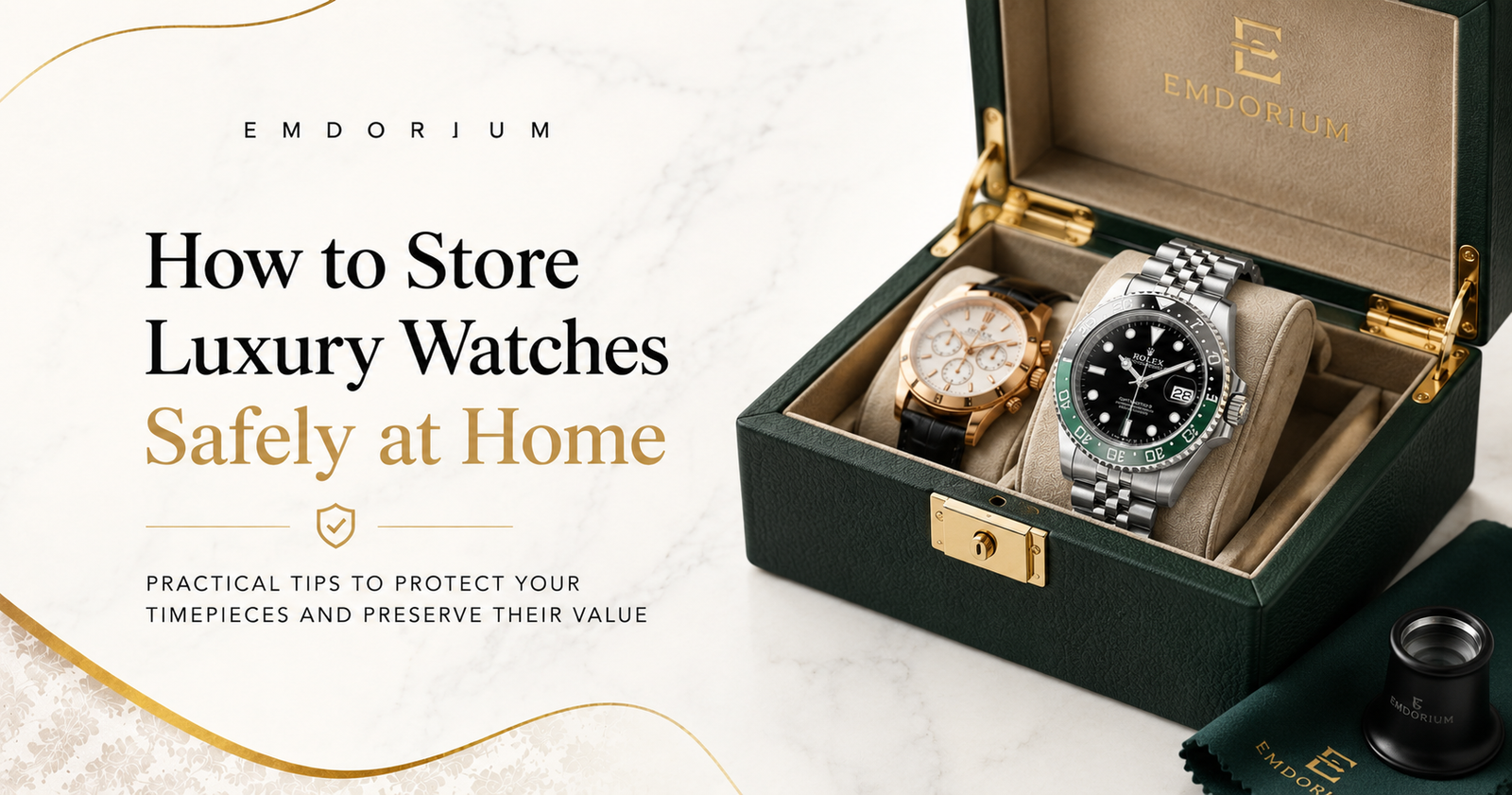
How to Store Luxury Watches Safely at Home
Your Watch Survived 100 Years of Engineering. Don’t Let a Drawer Ruin It.
A Rolex Submariner is engineered to withstand 300 metres of water pressure. It’s built from 904L Oystersteel a superalloy that resists corrosion in saltwater. Its sapphire crystal can withstand significant impact. Its movement is certified to -2/+2 seconds per day. It’s one of the most resilient precision instruments ever created.
And yet, the wrong storage conditions at home can do more damage to it than the ocean ever could.
Moisture seeping through an unprotected nightstand drawer. Magnetism from the phone you left next to it overnight. Scratches from that loose set of keys sharing the same shelf. UV light fading the dial through a sunny bedroom window. A leather strap rotting quietly in Dhaka’s monsoon humidity while the watch sits forgotten in a cupboard.
These aren’t dramatic disasters. They’re silent, incremental degradations the kind that strip value, compromise mechanical precision, and turn a ৳15-20 lakh investment into a watch that needs a ৳50,000 service years ahead of schedule.
The good news? Proper storage is straightforward. It doesn’t require a bank vault or a climate-controlled bunker. It requires knowledge, a few smart investments, and the discipline to treat your watches with the same care that the artisans who built them intended.
This guide covers everything from the five environmental threats hiding in your home to Bangladesh-specific climate solutions, from watch winders to safes, from a one-watch collection to a multi-piece portfolio. Whether you own a single Longines Flagship or a growing collection spanning Rolex to Grand Seiko to Omega this guide protects your investment.
The 5 Enemies of a Luxury Watch (And They’re All in Your Home)
Before we talk about what to do, you need to understand what you’re defending against. These five threats are present in every Bangladeshi home and each can silently degrade your watch.
1. Humidity and Moisture
Dhaka’s average humidity hovers between 70-85% for most of the year, spiking above 90% during monsoon season. That moisture is your watch’s number one enemy.
Even watches with significant water resistance ratings like the Omega Seamaster Diver 300M at 300 metres are designed to resist water intrusion during active use, not prolonged storage in humid environments. When a watch sits unworn in a humid room, moisture gradually infiltrates gaskets and seals (especially as they age), leading to condensation inside the crystal, corrosion of movement components, and degradation of lubricants.
Leather straps are especially vulnerable. Humidity causes leather to absorb moisture, swell, develop mould, and eventually crack or rot. The exquisite Casa Fagliano calfskin strap on a JLC Reverso can be permanently damaged by a single monsoon season of improper storage.
2. Magnetism
Your smartphone generates a magnetic field. So does your laptop, your tablet, your wireless charger, your Bluetooth speaker, and your microwave. In a typical Bangladeshi bedroom or home office, magnetic sources are everywhere and they’re close to where most people leave their watches overnight.
Magnetism disrupts the hairspring inside a mechanical watch, causing it to run fast sometimes dramatically. A magnetised Rolex Datejust can gain minutes per day instead of its certified seconds. While some watches like Omega’s Master Chronometer models, resistant to 15,000 gauss offer magnetic protection, most mechanical watches are vulnerable.
3. Sunlight and UV Exposure
Direct sunlight does two things to a luxury watch. First, UV radiation fades dials tropical-pattern dials, painted indices, and luminous material are particularly susceptible. Second, heat from sustained sun exposure can degrade gaskets and cause lubricants to thin, affecting movement performance.
That beautiful window ledge in your Gulshan apartment where the morning sun floods in? Worst possible place for a watch.
4. Physical Impact and Scratching
A watch sitting loose on a hard surface a marble countertop, a wooden nightstand, a glass shelf is exposed to constant micro-scratch risk. Every time you set something down beside it, every time it slides slightly as a door closes tiny marks accumulate. Worse, storing multiple watches touching each other guarantees bracelet-on-crystal contact that creates scratches no amount of polishing can fully remove.
5. Dust and Particulates
Dhaka’s air quality means dust infiltration is a constant reality. Fine particulate matter settling on a watch case, between bracelet links, and around the crown eventually works its way into the mechanism especially if the crown gaskets aren’t perfectly sealed. Over time, dust inside a movement acts as an abrasive, accelerating wear on precision components.
The Complete Home Storage Guide: 8 Expert Rules
Follow these eight rules, and your watches will stay in the condition they deserve whether you own one piece or twenty.
Rule 1: Always Store Watches in Their Original Box or a Dedicated Watch Box
The box your watch came in isn’t just packaging it’s engineered storage. Luxury watch brands design their boxes with soft fabric linings, cushioned pillows, and compartmentalised interiors specifically to protect the watch from impact, dust, and contact damage.
If you own multiple watches, invest in a dedicated multi-slot watch box with individually cushioned compartments, a closing lid, and a soft interior lining (velvet, microfibre, or suede). Each watch should have its own slot never stacked, never touching.
Always store watches face up to protect the crystal and dial. Wrap the watch around the cushion pillow to mimic the natural wrist position, keeping the bracelet or strap in its proper shape.
Rule 2: Control Humidity with Silica Gel Packets
This is the simplest, cheapest, and most effective climate-control measure for Bangladeshi watch owners.
Place 2-3 silica gel desiccant packets inside your watch box. These absorb excess moisture from the air, maintaining a drier microenvironment inside the box even when your room’s humidity is 85%. Replace them every 3-4 months they lose effectiveness over time as they absorb moisture.
For higher-value collections, consider a small electric dehumidifier in the room where you store your watches. Maintaining room humidity between 40-60% is ideal for luxury watch storage.
Rule 3: Keep Watches Away from Magnetic Sources
Create a “magnetic exclusion zone” around your watch storage. This means your watch box should sit at least 15-20 centimetres away from smartphones, laptops, tablets, wireless chargers, Bluetooth speakers, and any other electronic devices.
The nightstand rule: never place your watch directly next to your phone overnight. This is the most common source of accidental magnetisation. Either keep your phone on a different surface or move your watch box to a dedicated shelf.
If you suspect a watch has been magnetised (it’s running fast or erratically), a watchmaker can demagnetise it in minutes using a demagnetiser tool. At Hourglass Emporium, we can check for magnetisation during any consultation just reach out to our experts.
Rule 4: Store in a Cool, Dark, Dry Location
The ideal storage location is:
- Cool: 18-25°C (avoid attics, kitchens, or rooms with significant temperature fluctuation)
- Dark: No direct sunlight or sustained artificial light on the dial
- Dry: Away from bathrooms, kitchens, and exterior walls that may attract condensation
- Stable: Avoid rooms with frequent temperature changes (AC cycling on and off)
A bedroom wardrobe or a dedicated drawer in an air-conditioned room works perfectly for most collectors in Bangladesh. The key is consistency steady temperature and humidity, day after day.
Rule 5: Separate Leather Straps from Metal Bracelets
Leather and metal have different storage needs and mixing them in humid environments is risky.
Leather straps should be unfastened (not clasped closed) during storage to maintain their shape and allow airflow. If possible, remove the watch from the strap for extended storage periods and store the strap separately in a breathable pouch never in sealed plastic, which traps moisture.
Metal bracelets are more resilient but should still be wiped clean with a soft microfibre cloth before storage to remove sweat, oils, and skin cells that can cause tarnishing over time.
Watches with interchangeable strap systems like the Cartier Santos with its QuickSwitch mechanism offer an advantage here. You can remove the leather strap for monsoon-season storage and keep the watch on its metal bracelet instead.
Rule 6: Wind Automatic Watches Periodically (Or Use a Winder)
An automatic watch that sits unworn for extended periods will stop running. While this isn’t immediately harmful, lubricants inside the movement can settle or congeal over very long dormancy periods (months to years), potentially affecting the movement when it’s restarted.
If you don’t use a watch winder, manually wind your automatic watches every 2-4 weeks and let them run for a few hours. This circulates the lubricants and keeps the movement healthy.
For watches with complex complications like the JLC Reverso Duoface Calendar with its day, date, month, and moon phase a watch winder is especially valuable because resetting all those complications is time-consuming.
Rule 7: Keep All Documentation Separate but Secure
Your warranty cards, purchase receipts, service records, original hang tags, and certificate of authenticity should never be stored inside the watch box. Why? Because if the watch box is stolen, you lose everything watch and documentation together.
Store documentation in a separate secure location ideally a fireproof document safe or a sealed, labelled envelope in a different room. This ensures that even in the worst-case scenario, you retain the paperwork that proves authenticity and protects insurance claims.
At Hourglass Emporium, every watch we sell comes with complete, verified documentation and we always advise our clients to store papers separately from the watch itself.
Rule 8: Clean Before Storing
Never store a watch dirty. Sweat, skin oils, dust, and environmental residue left on a watch during storage accelerate corrosion, tarnishing, and strap degradation.
Before placing your watch in its box:
- Wipe the case and crystal with a clean, dry microfibre cloth
- Use a soft brush to clean between bracelet links where dust and skin cells accumulate
- For leather straps, wipe with a dry cloth and let air-dry briefly before storing
- For rubber or silicone straps, wipe with a slightly damp cloth and dry completely
A clean watch stored in a controlled environment will look and perform as well in ten years as it does today.
Watch Winders: Do You Need One?
Watch winders are one of the most debated topics in horology. Here’s a clear-headed assessment.
What a watch winder does: It’s a motorised device that gently rotates your automatic watch, mimicking the motion of your wrist and keeping the mainspring wound. This prevents the watch from stopping and maintains the accuracy of the time and date displays.
When you need one:
- You own 3+ automatic watches and rotate between them meaning some sit unworn for weeks at a time
- You own watches with complex complications (perpetual calendar, moon phase, world time) that are cumbersome to reset after the watch stops
- You want your watches ready to wear at any moment without manual winding and time-setting
When you don’t need one:
- You own 1-2 watches and wear one daily it stays wound naturally
- Your watches are manual-wind (like the JLC Reverso Monoface with Calibre 822) winders don’t apply to manual-wind watches
- Your watches are quartz (like the Movado Stratus) winders serve no purpose for quartz movements
Important considerations:
- Match the TPD (Turns Per Day) and direction to your specific watch. A Rolex calibre 3235 winds in both directions and typically needs 650-800 TPD. An incorrect setting can overwind or underwear the mainspring.
- Quality matters. A cheap winder with a loud, vibrating motor can actually cause more harm than good the vibrations can affect movement accuracy. Invest in a winder with a silent motor and adjustable settings.
- Don’t overuse it. Some horologists argue that constant winding subjects the movement to unnecessary wear. A reasonable approach: use the winder intermittently, not 24/7. Wind the watch for a day or two, then let it rest.
For your specific watches at Hourglass Emporium: Our automatic watches that benefit most from winders include the Rolex Submariner 126610LV (Cal. 3235, bidirectional, ~650 TPD), the Omega Speedmaster Moonshine Gold (Cal. 3861, manual-wind no winder needed), and the Grand Seiko Spring Drive Katana (Cal. 9R65, Spring Drive hybrid winder compatible).
Storage Solutions by Collection Size
| Collection Size | Recommended Storage | Key Features to Look For | Budget Range |
|---|---|---|---|
| 1-2 watches | Original box + silica gel packets | Cushioned interior, lid closure, compact size | ৳0 (use original packaging) |
| 3-5 watches | Dedicated watch box (5-8 slots) | Individual cushioned slots, glass or solid lid, lock, soft lining | ৳3,000 – ৳15,000 |
| 6-10 watches | Watch box + watch winder (2-4 unit) | Built-in winders, adjustable TPD settings, silent motor, humidity control | ৳15,000 – ৳50,000 |
| 10+ watches | Watch safe or dedicated cabinet | Fireproof/waterproof rating, integrated winders, biometric lock, climate control | ৳50,000 – ৳3,00,000+ |
| Travel | Travel watch roll or case (1-3 units) | Shock-resistant, compact, individual cushioning, hard-shell exterior | ৳2,000 – ৳10,000 |
Bangladesh-Specific Storage Tips: Surviving Dhaka’s Climate
Bangladesh presents unique storage challenges that most international watch care guides don’t address. Here’s what you need to know specifically for Dhaka, Chittagong, Sylhet, and other cities.
Monsoon season (June-October) is high-alert season. Humidity regularly exceeds 85-90%. During these months, double your silica gel packets, check them monthly, and consider running a small dehumidifier in your storage room. If you own leather-strapped watches like the Frederique Constant Worldtimer or the JLC Reverso, switch to metal bracelets or rubber straps for daily wear during monsoon and store the leather straps separately in a breathable pouch with silica gel.
Load shedding and AC cycling. Power cuts mean your air conditioning stops and temperatures rise rapidly in Dhaka’s heat. When the AC resumes, the temperature drops quickly. This constant cycling creates condensation risk. If your home experiences frequent load shedding, store your watches in a well-insulated location (a wardrobe or drawer maintains more consistent temperature than an open shelf) and avoid window-adjacent surfaces where temperature fluctuation is greatest.
Dhaka’s air quality. Fine particulate matter (PM2.5) levels in Dhaka regularly exceed WHO guidelines. This dust infiltrates homes and settles on everything including watch cases and bracelets. Keeping watches in closed boxes is essential, not optional. Wipe your watches with a microfibre cloth before and after each wearing to prevent dust from working into crown gaskets and bracelet links.
The “almari” solution. Many Bangladeshi families keep valuables in a steel almari (wardrobe). This is actually a reasonable storage environment for watches the enclosed metal structure provides some insulation from temperature swings and humidity, and the doors keep out dust and light. Add silica gel packets inside, a soft-lined watch box on a shelf, and you have a perfectly adequate watch storage solution for most collections.
Avoid the bathroom. This should be obvious but bears repeating: never leave a watch in or near a bathroom. The humidity spikes from hot showers create the most concentrated moisture exposure in your entire home.
Securing Your Collection: Safes, Insurance, and Documentation
As your collection grows, security becomes a serious consideration. Luxury watches are small, valuable, and highly desirable making them prime targets.
Home safes. For collections valued above ৳20-30 lakh, a bolted-down, fireproof home safe is a worthwhile investment. Look for safes with fireproof rating (1-2 hours at 1,000°C), waterproof seals, bolt-down mounting (a small safe that isn’t bolted down can simply be carried away), and padded interior. Some premium safes from brands like Wolf, Buben & Zörwe, and Döttling include integrated watch winders combining security with functionality.
Insurance. Your homeowner’s insurance may not adequately cover luxury watches or may not cover them at all outside the home. Consider dedicated personal property insurance or a rider specifically for watches. Keep photographs of each watch (front, back, and serial number close-up) alongside purchase receipts and authentication documentation. If you’ve purchased from Hourglass Emporium, your verified documentation provides exactly the proof an insurer needs.
Cataloguing your collection. Maintain a simple spreadsheet or dedicated app logging each watch’s brand, model, reference number, serial number, purchase date, purchase price, and estimated current value. This serves three purposes: insurance claims, service scheduling, and long-term portfolio tracking. Update it with each new acquisition.
Never share serial numbers publicly. As we discussed in our serial number verification guide, posting serial numbers on social media or forums enables counterfeiters to clone your watch’s identity. Keep serial information private.
Quick-Reference: Storage Needs by Watch Type
| Watch | Movement Type | Winder Needed? | Strap Care Notes | Key Storage Concern |
|---|---|---|---|---|
| Rolex Submariner 126610LV | Automatic (Cal. 3235) | Yes, if not worn regularly | Steel bracelet wipe after wear | Magnetism, humidity |
| Rolex Datejust 41 Grey | Automatic (Cal. 3235) | Yes, if rotating | Steel bracelet low maintenance | Magnetism, dust |
| Omega Speedmaster Moonshine Gold | Manual wind (Cal. 3861) | No manual wind | Leather strap humidity sensitive | Humidity, UV on gold |
| Omega Seamaster Diver 300M | Automatic (Cal. 8800) | Yes, if not worn regularly | Steel bracelet resilient | Magnetism (though Master Chronometer rated) |
| Grand Seiko SBGR325 | Automatic (Cal. 9S65) | Yes, if rotating | Steel bracelet wipe to preserve Zaratsu polish | Scratching on polished surfaces |
| Grand Seiko Spring Drive Katana | Spring Drive (Cal. 9R65) | Optional winder compatible | Leather strap monsoon-sensitive | Humidity on leather, dust |
| JLC Reverso Monoface | Manual wind (Cal. 822) | No manual wind | Leather (Casa Fagliano) premium care | Humidity, strap rot if neglected |
| Cartier Santos WSSA0048 | Automatic | Yes, if not worn regularly | QuickSwitch swap to rubber for monsoon | Strap management by season |
| Nomos Tetra Neomatik Blue | Automatic (DUW 3001) | Yes, if not worn regularly | Leather strap store separately in humidity | Humidity, numbered case back preserve carefully |
| Hublot Classic Fusion King Gold | Automatic (HUB1143) | Yes, if not worn regularly | Rubber strap wipe clean, avoid prolonged heat | Gold surface avoid scratching |
| Movado Stratus Chronograph | Quartz | No quartz | Steel bracelet low maintenance | Remove battery if storing long-term |
| Longines Flagship Day-Date | Automatic (Cal. L636) | Yes, if rotating | Two-tone bracelet wipe after wear | Dust between links |
Frequently Asked Questions
Q: What’s the best way to store a Rolex at home?
A: Store your Rolex in its original box or a cushioned watch box, with 2-3 silica gel packets to control humidity. Keep it away from smartphones and other magnetic sources (minimum 15-20cm distance). Store in a cool, dark, dry location ideally an air-conditioned room. If you’re not wearing it regularly, manually wind it every 2-4 weeks or use a quality watch winder set to the correct TPD for your specific calibre.
Q: Do I need a watch winder for my automatic watch?
A: Only if you own multiple automatic watches and rotate between them frequently, or if your watch has complex complications (perpetual calendar, moon phase) that are difficult to reset. For a single watch worn daily, a winder is unnecessary your wrist does the work. Manual-wind and quartz watches never need winders.
Q: How do I protect leather watch straps in Bangladesh’s humidity?
A: During monsoon season (June-October), consider switching to metal bracelets or rubber straps for daily wear. Store leather straps separately in a breathable pouch (never sealed plastic) with silica gel packets. Unfasten the strap (don’t leave it clasped closed) to maintain its shape and allow airflow. Wipe clean before storage and allow to air-dry.
Q: Can humidity damage a waterproof watch like the Omega Seamaster?
A: Water resistance protects against active water exposure submersion, splashing, rain. Prolonged storage in high humidity (85%+) is a different threat. Moisture gradually infiltrates aging gaskets, causing condensation inside the crystal and corrosion of movement components. Even a 300m-rated Omega Seamaster benefits from humidity-controlled storage.
Q: বাংলাদেশে ঘড়ি সংরক্ষণে সবচেয়ে বড় ঝুঁকি কী? (What’s the biggest storage risk for watches in Bangladesh?)
A: আর্দ্রতা বিশেষ করে বর্ষাকালে যখন আর্দ্রতা ৮৫-৯০% ছাড়িয়ে যায়। সিলিকা জেল প্যাকেট ব্যবহার করুন, এয়ার কন্ডিশনযুক্ত ঘরে রাখুন, এবং চামড়ার স্ট্র্যাপ আলাদাভাবে সংরক্ষণ করুন। Hourglass Emporium থেকে আপনার ঘড়ির নির্দিষ্ট সংরক্ষণ পরামর্শের জন্য যোগাযোগ করতে পারেন।
Q: Should I store watches in a bank safe deposit box?
A: For very high-value collections (৳50 lakh+), a bank safe deposit box offers maximum security 24/7 surveillance, fireproof, theft-proof. The trade-off is inconvenience: you can’t enjoy your watches at home or quickly swap pieces. A practical compromise for most collectors in Bangladesh is a quality home safe (bolted down, fireproof) combined with proper insurance coverage.
Q: How often should I service a stored watch?
A: Even if unworn, most luxury watch manufacturers recommend servicing every 5-7 years (Rolex) or 5-8 years (Omega). During service, gaskets are replaced, lubricants refreshed, and the movement cleaned all essential for long-term health. If a watch has been stored for over 2 years without running, have it professionally inspected before wearing again.
Protect Today, Appreciate Tomorrow
Your luxury watch was built to last generations. The question is whether it will arrive at the next generation in the condition it deserves.
Proper storage isn’t complicated. A quality watch box. Silica gel packets. Distance from magnets and sunlight. A clean microfibre cloth. These are small investments that protect large ones. In Bangladesh’s challenging climate with its monsoon humidity, dust-laden air, and temperature fluctuations these precautions aren’t optional luxuries. They’re essential care.
Every watch in the Hourglass Emporium collection has been stored, handled, and transported under conditions that meet the strictest standards. When a watch leaves our care and enters yours, we want it to stay in the same condition not just for you, but for the person who’ll wear it after you.
Whether you’re protecting a Rolex GMT-Master II Rootbeer worth ৳24 lakh, a Christopher Ward C65 Dune Bronze worth ৳16,500, or a Grand Seiko SBGH337 Nova Purple limited to 200 pieces worldwide the care it receives at home determines whether it appreciates in value or depreciates through neglect.
Treat your watches the way their makers intended. They’ll reward you for decades.
Explore our authenticated collection at Hourglass Emporium. Need advice on storing a specific watch? Contact our team we’re always happy to help.
📞 Hotline: +880 1973 676 591 💬 WhatsApp: +880 1973 676 591 📧 Email: info@hourglassemporium.com 🌐 Visit: hourglassemporium.com
A well-stored watch is a well-loved watch. And a well-loved watch lasts forever.