Rolex vs Omega: Which Luxury Watch Holds Better Value?
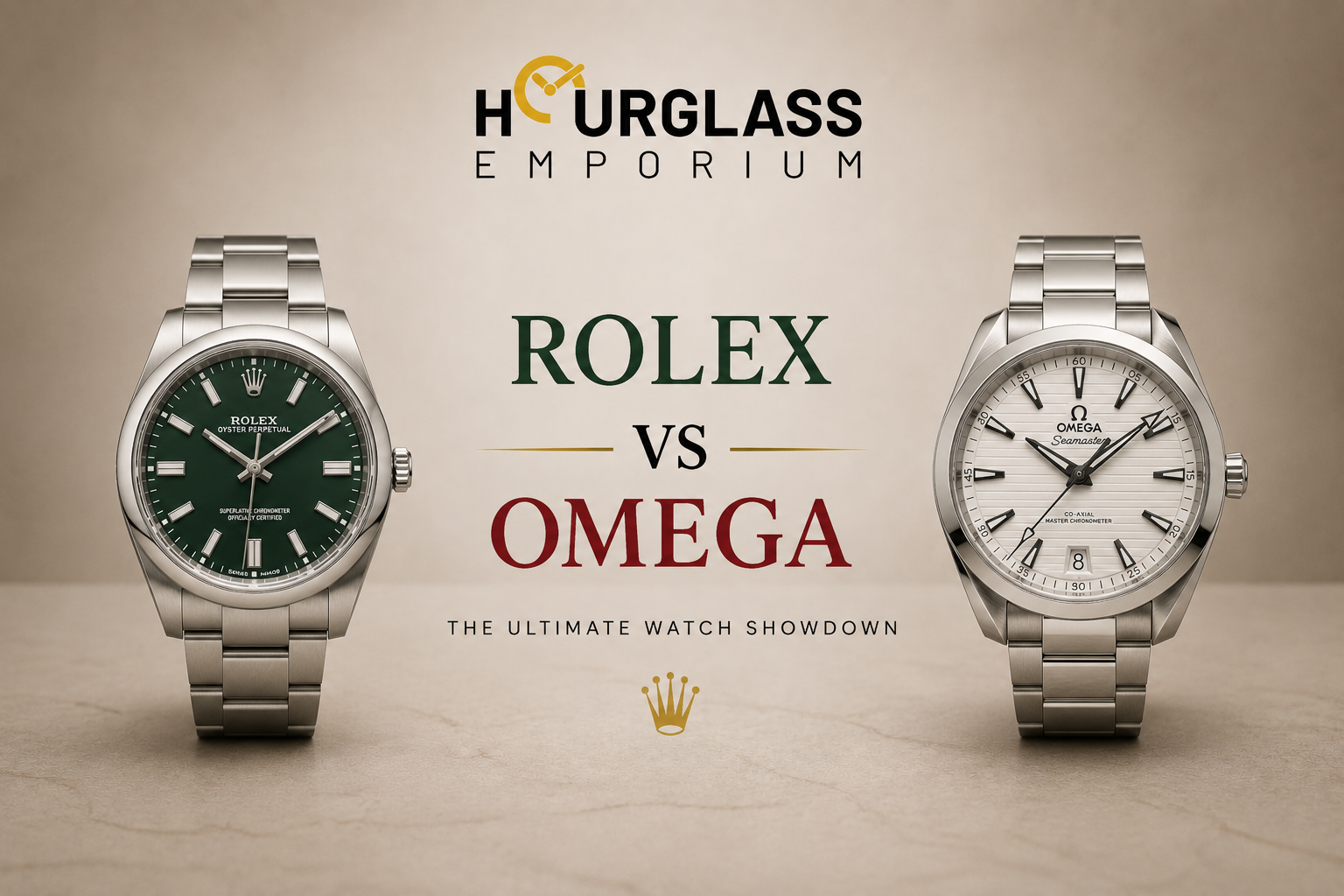
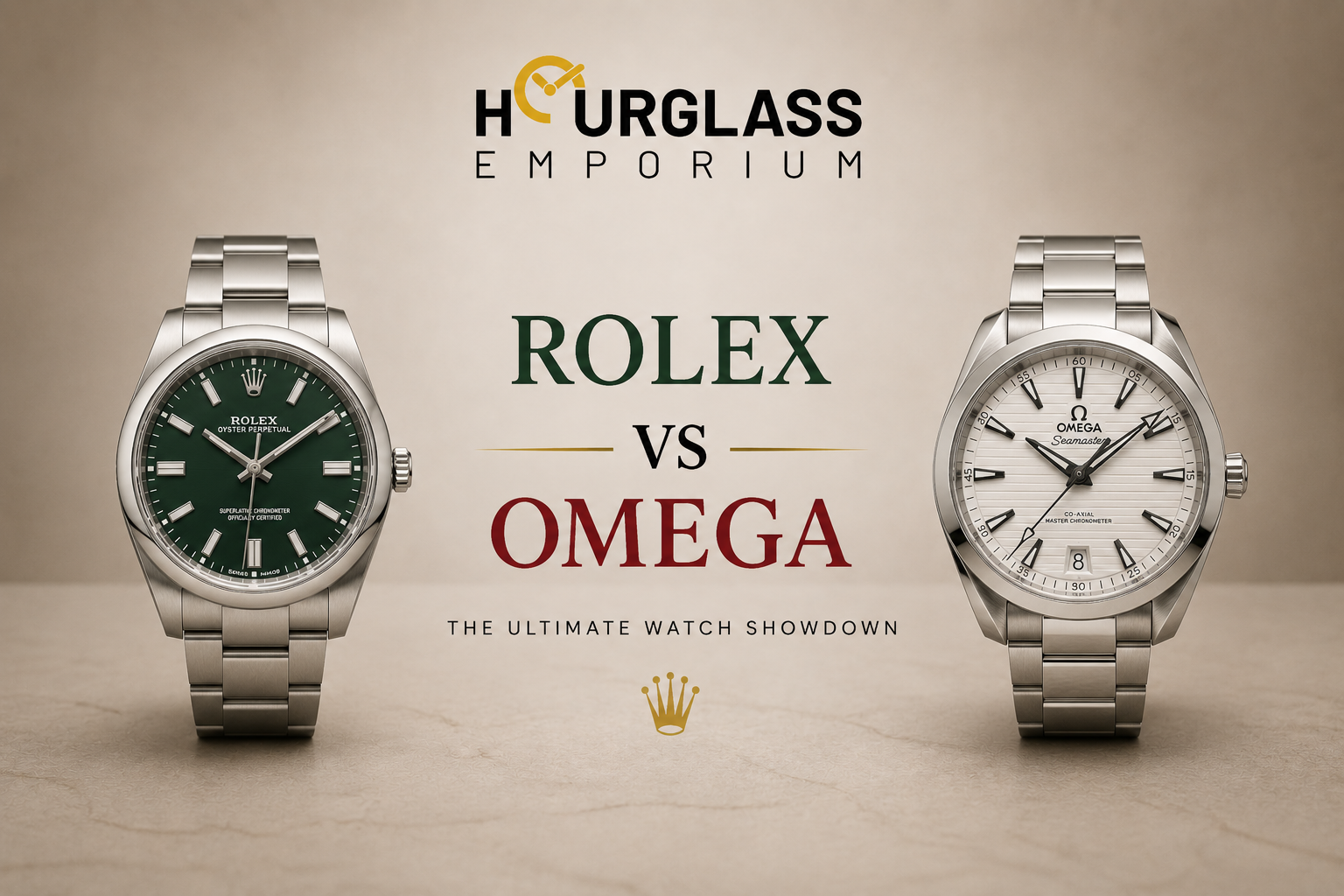
The Rolex vs Omega debate is one of the most searched questions in luxury horology – and for good reason. These are the two most recognised Swiss watch brands in the world, but they perform very differently when it comes to long-term value.
Rolex consistently outperforms Omega on the secondary market, with sport models like the Submariner and GMT-Master II often retaining 80% to 120% of their original retail price. Omega watches typically trade 30–38% below retail on average, though select limited editions and vintage Speedmaster references can hold or even gain value over time.
This distinction matters now more than ever. The pre-owned luxury watch market has grown significantly, and buyers across Bangladesh are increasingly treating timepieces as both personal statements and long-term assets.
At Hourglass Emporium, we curate an authenticated collection of both Rolex and Omega watches, including pre-owned and new pieces across a wide range of references. Whether you are weighing your first serious watch investment or building a collector’s portfolio, our Rolex and Omega collection gives you access to the exact models this comparison covers. In this blog, we’ll break down resale data, brand prestige, movement credentials, and exactly which models from each brand give you the strongest return on investment.
Rolex vs Omega on Value Retention
Rolex sport models routinely sell at or above their original retail price. Omega, with a few notable exceptions, typically trades below retail once it leaves the authorised dealer. That is the headline. But the reasons behind it, and the exceptions to it, are where the real story lives.
What “Holding Value” Actually Means for a Watch?
A watch “holds its value” when you can sell it on the pre-owned market at or close to what you originally paid. Appreciation means it sells for more. Depreciation means it sells for less.
Most consumer goods depreciate the moment you use them. Luxury watches are different. The right brand, the right reference, and the right condition can make a watch behave more like property than a purchase. That is what separates a watch investment from a watch you simply wear.
Brand Prestige and Global Recognition
Numbers tell this story cleanly. According to Interbrand, Rolex commands 100% international brand recognition. Omega sits at approximately 70%.
That 30% gap is not trivial. It translates directly into pricing power. A buyer in Tokyo, London, Geneva, or Dhaka knows what a Rolex is. They know what it signals. That universal understanding is what keeps demand high and supply scarce – the two conditions that protect resale value.
Why Brand Recognition Drives Resale Prices
Think about it from a buyer’s perspective. When you go to resell a watch, you are not just selling the metal and the movement. You are selling the story the watch tells. Rolex tells a story that crosses every language, every culture, every income bracket.
Omega tells a great story too – the Moon, James Bond, the Olympics. But it is a story that requires some telling. And in the resale market, watches that need explaining always trade at a discount to watches that need none.
Rolex Resale Value: The Numbers
Rolex has engineered scarcity into its business model. The company produces fewer watches than the market demands – deliberately. The result? Waitlists at authorised dealers stretching years for popular models. And when buyers cannot get a Rolex new, they pay premiums on the pre-owned market.
According to data tracked by Diamond Banc from real-world transactions in 2025, Rolex sport models like the Submariner, Daytona, and GMT-Master II frequently retain 80% to 120%+ of their original retail price. Some discontinued references have sold for multiples of their original retail value.
Which Rolex Models Hold Value the Best?
Submariner. The most recognisable dive watch in history. Clean, timeless, and consistently in demand. Pre-owned examples in good condition rarely sell at a loss.
GMT-Master II. Built for travellers, adopted by collectors. The two-tone “Pepsi” and “Batman” bezels have achieved near-mythological collector status. Our pre-owned Rolex GMT-Master II Ref 116710LN is exactly the reference serious collectors look for.
Daytona. One of the hardest watches to source new anywhere in the world. The scarcity is real – and it protects the resale value accordingly.
Datejust. The most versatile Rolex in the collection. Not a speculator’s watch, but a holder. A 2020 Rolex Datejust 41 Grey Dial Ref 126334 with box and papers retains strong value precisely because the design has remained visually consistent for decades. For a current-year reference, our Rolex Datejust 41mm Bright Blue Dial – Ref. 126334 (2022) represents one of the most desirable dial variations on this reference.
Is a Pre-Owned Rolex Worth Buying?
Yes. And for investment purposes, a pre-owned Rolex often makes more sense than a new one. Here is why. A new Rolex purchased at retail suffers its only real depreciation hit immediately after purchase – before you have even worn it home. A pre-owned example, already past that initial dip, tends to hold stable or appreciate from there.
One important caveat: always buy with the original box and papers. Research from Diamond Banc confirms that a complete set adds 15–20% to resale value compared to the same watch without provenance documentation.
For those looking at a pre-owned entry point, our Rolex Submariner Date Ref 126610LV (2023) offers one of the most recognisable references in mint condition.
Omega Resale Value: A Different Kind of Investment
Here is where the honest conversation gets more nuanced. According to WatchCharts data from 2025, in-production Omega watches trade approximately 38% below their retail price on average. The Speedmaster Professional Moonwatch, one of Omega’s most celebrated models, trades around 32% below its retail price.
That sounds like a negative. But it is not the whole story.
Which Omega Models Hold Their Value Best?
Not all Omegas depreciate equally. The models that hold the strongest resale value share a common trait: they are either historically significant, limited in production, or both.
Omega Speedmaster “Moonwatch.” The only watch ever worn on the Moon. NASA-certified, historically singular, and genuinely iconic. Certain vintage references and limited editions have been appreciated meaningfully. The Omega Speedmaster Silver Snoopy Award 50th Anniversary is a prime example – a limited-production piece tied directly to space history, the exact type of Omega that collectors fight over.
Seamaster 300M. Especially James Bond-connected references and titanium/ceramic variants. Strong secondary market performance for a production watch. Our Omega Seamaster Diver 300M Blue Dial is a key reference in this category.
Vintage Speedmasters (pre-Moon references). Rare, increasingly difficult to source in good condition, and growing in collector attention year on year.
The Omega Advantage – More Watch for Your Money
But here is the thing. A luxury watch comparison that only looks at resale value misses half the picture.
Omega’s Co-Axial Master Chronometer movements are tested to the METAS standard – the most rigorous certification in modern Swiss watchmaking. These movements perform to 0 to +5 seconds per day under real-world conditions including magnetic fields up to 15,000 gauss. Rolex movements are excellent. But Omega’s are technically superior by most measurable standards. At a lower entry price point, you get a more technically advanced movement. For buyers who actually wear their watches rather than lock them in a safe, that matters.
Our Omega Seamaster 300 Co-Axial Master Chronometer 41mm is a precise example of that philosophy – a watch built to be used, worn, and enjoyed.
Rolex vs Omega : Head-to-Head Comparison
| Category | Rolex | Omega |
| Founded | 1905 | 1848 |
| Brand Recognition | 100% (Interbrand) | ~70% (Interbrand) |
| Average Resale Retention | 80–120%+ (sport models) | ~62% of retail (average production) |
| Entry Price (new) | ~৳700,000+ | ~৳425,000+ |
| Movement Certification | Superlative Chronometer (COSC + Rolex) | Master Chronometer (METAS) |
| Best Investment Model | Submariner, Daytona, GMT-Master II | Speedmaster Moonwatch, Seamaster 300M |
| Availability | Difficult (waitlists) | Accessible |
| Technical Innovation | Strong | Leading (Co-Axial, anti-magnetic) |
Which Watch Should You Actually Buy?
The answer depends entirely on what you want the watch to do. If you are buying a watch the way you might buy property – expecting it to retain or gain value, knowing you could liquidate it in five years – Rolex is the answer. The brand has spent over a century building the conditions that protect resale value: scarcity, consistency, and universal recognition.
But if you want the most watch for your investment, technically and aesthetically, Omega is genuinely hard to beat.
Buy Rolex If You:
- Want the strongest long-term resale value and secondary market liquidity
- Are building a collection that signals universal prestige and status
- Are comfortable with a higher entry price and limited availability on new models
- Want a timepiece that functions as both a luxury object and a recognisable financial asset
Buy Omega If You:
- Want cutting-edge movement technology – specifically METAS-certified, anti-magnetic precision – at a more accessible price
- Are drawn to historical significance (space, Olympics, motorsport) and collector depth
- Are buying a limited-edition reference with genuine appreciation potential
- Want more dial variety, design creativity, and technical specification per Taka spent
Final Thoughts About Rolex vs Omega
The Rolex vs Omega question does not have one universal answer. It has two, depending on what you are actually buying the watch for. Rolex wins on resale value. That is backed by data, collector demand, and decades of scarcity-driven pricing. If your watch needs to hold its worth on the open market, there is no stronger bet in Swiss horology at this price tier.
Omega wins on technical excellence and accessible luxury. Its Master Chronometer movements are among the most precisely certified in the world. Its historical connection to space exploration gives certain references a collector appeal that no marketing budget could manufacture.
The best decision is not always the most expensive one. It is the most informed one. Get our latest authenticated collection of Rolex and Omega watches at Hourglass Emporium Bangladesh- new and pre-owned, with full documentation, at transparent pricing in BDT.
Frequently Asked Questions (FAQs)
Question: Does Rolex hold value better than Omega?
Answer: Yes. Rolex sport models consistently retain 80–120%+ of their original retail value on the secondary market, while Omega production watches average around 62% of retail. Rolex’s controlled supply and 100% global brand recognition are the primary drivers of this difference.
Question: Which Omega watch holds its value best?
Answer: The Omega Speedmaster Professional Moonwatch holds the strongest resale value among production Omegas, particularly vintage pre-Moon references and limited editions such as the Silver Snoopy Award. The Seamaster 300M also performs well, especially James Bond editions and ceramic-bezel variants.
Question: Is buying a pre-owned Rolex a good investment?
Answer: Pre-owned Rolex watches often make better investment sense than new ones. The initial retail depreciation has already occurred, and a well-preserved example with box and papers can hold stable or appreciate. According to Diamond Banc, a complete set adds 15–20% to resale value versus the same watch without documentation.
Question: What makes the Omega Speedmaster a collector’s watch?
Answer: The Speedmaster is the only watch ever certified by NASA and worn on the Moon during the Apollo 11 mission in 1969. That historical fact is permanently attached to the model. Combined with limited-edition releases, a consistent design lineage, and growing collector attention worldwide, certain Speedmaster references appreciate in ways that standard production Omegas do not.
Question: Should I buy a Rolex or Omega as my first luxury watch in Bangladesh?
Answer: For a first luxury watch with strong resale confidence, a pre-owned Rolex Datejust or Submariner is the safer investment. If budget is a priority and you want exceptional movement technology and design, an Omega Seamaster Aqua Terra or Seamaster 300M offers outstanding value at a lower entry price.