How to Verify Luxury Watch Serial Numbers
The Tiny Number That Protects Your ৳20 Lakh Investment
Somewhere on every genuine luxury watch hidden between the lugs, laser-etched on the case back, or engraved on the inner bezel sits a sequence of numbers and letters that can save you from the most expensive mistake of your life.
That sequence is the serial number. And in 2026’s luxury watch market, where counterfeits have become sophisticated enough to fool even experienced buyers, knowing how to find, read, and verify a serial number is the single most important skill any watch buyer in Bangladesh can develop.
Here’s the uncomfortable truth: a convincing fake Rolex Submariner can look perfect from two feet away. The weight might feel right. The Cyclops might magnify correctly. The sweep might be smooth. But the serial number the DNA of the watch is where the deception breaks down. Counterfeiters can replicate appearances. They cannot replicate provenance.
This guide covers serial number verification for every major brand we carry at Hourglass Emporium Rolex, Omega, Grand Seiko, Tudor, Cartier, Jaeger-LeCoultre, Hublot, Zenith, and more. By the end, you’ll know exactly where to look, what to look for, and when a number is telling you that something isn’t right.
Let’s decode what’s on your wrist.
What Is a Watch Serial Number and Why Does It Matter?
A serial number is a unique alphanumeric identifier that a manufacturer assigns to each individual watch during production. No two watches from the same manufacturer should ever share the same serial number. Think of it as the watch’s fingerprint a permanent, unchangeable mark of identity.
What a serial number tells you:
Authenticity. A genuine serial number, properly engraved in the correct location with the correct format, is one of the strongest indicators that a watch is real. Counterfeiters frequently get serial numbers wrong wrong format, wrong location, wrong engraving quality, or numbers that don’t correspond to any known production record.
Production date. For many brands particularly pre-2010 Rolex and Omega the serial number can be cross-referenced against production databases to determine when the watch was manufactured. This is essential for verifying that the watch’s age matches its claimed history.
Provenance chain. The serial number links the watch to its warranty card, service records, and ownership history. A genuine watch with matching serial numbers across the case, rehaut, warranty card, and service documentation tells a consistent story. A fake tells conflicting ones.
Resale value. A watch with a verifiable, authenticated serial number and matching documentation commands 15-25% more on the secondary market than a “watch only” piece. The serial number is the foundation of that documentation chain.
For buyers in Bangladesh where the luxury watch market is growing rapidly but the authentication infrastructure is still developing serial number verification isn’t optional. It’s your first line of defence against counterfeits, and the first check that any trusted reseller like Hourglass Emporium performs during authentication.
Brand-by-Brand Serial Number Guide
Every luxury watch brand uses a different serial number system. Here’s exactly where to find them and what to look for on each brand we carry.
Rolex
Rolex serial numbers are the most studied, most counterfeited, and most important to understand.
Where to find it:
On modern Rolex watches (2005 onwards), the serial number is laser-engraved on the rehaut the inner bezel ring visible at the 6 o’clock position when looking directly at the dial. You’ll see the serial number engraved alongside the repeating “ROLEX ROLEX ROLEX” text.
On pre-2005 models, the serial number is engraved on the case between the lugs at the 6 o’clock position. You’ll need to remove the bracelet to see it this is best done by a professional to avoid scratching the case.
The model number (reference number) is found between the lugs at the 12 o’clock position.
What genuine looks like:
Genuine Rolex serial engravings are deep, precise, laser-sharp, and perfectly aligned. Every character is evenly spaced and consistently sized. Running your fingernail over a genuine Rolex serial, you can feel the depth of the engraving it’s been acid-etched or laser-cut, not stamped.
What fake looks like:
Counterfeits typically show shallow, uneven, or sandy-feeling engravings. Characters may be inconsistently spaced. The font may look subtly wrong. On the rehaut, fake serial numbers often misalign with the hour markers a dead giveaway.
The scrambled serial era (2010-present):
Since 2010, Rolex has used randomised 8-character alphanumeric serial numbers that don’t follow a sequential pattern. This means you can no longer determine the production year from the serial alone you’ll need the warranty card or professional authentication. This change was designed to combat counterfeiting.
Cross-reference checklist for Rolex:
- Serial on the rehaut must match the serial on the warranty card
- Serial on the warranty card must match the serial on any service records
- The reference number (between 12 o’clock lugs) must correspond to the correct model
- On transitional-era watches (2005-2008), the serial may appear both on the rehaut and between the lugs both must match
Hourglass Emporium Rolex examples: When we authenticate a Rolex Datejust 41 (Ref. 126334), we verify the serial across the rehaut, the warranty card, and the case back plus we confirm that the reference number 126334 correctly corresponds to a 41mm Datejust with the specific bezel and material configuration present on the physical watch. On our Rolex Submariner No Date 114060, we verify the serial matches the discontinued reference’s known production window.
Omega
Omega uses a different system than Rolex, and understanding it is essential for authenticating the Seamasters, Speedmasters, and Aqua Terras in our collection.
Where to find it:
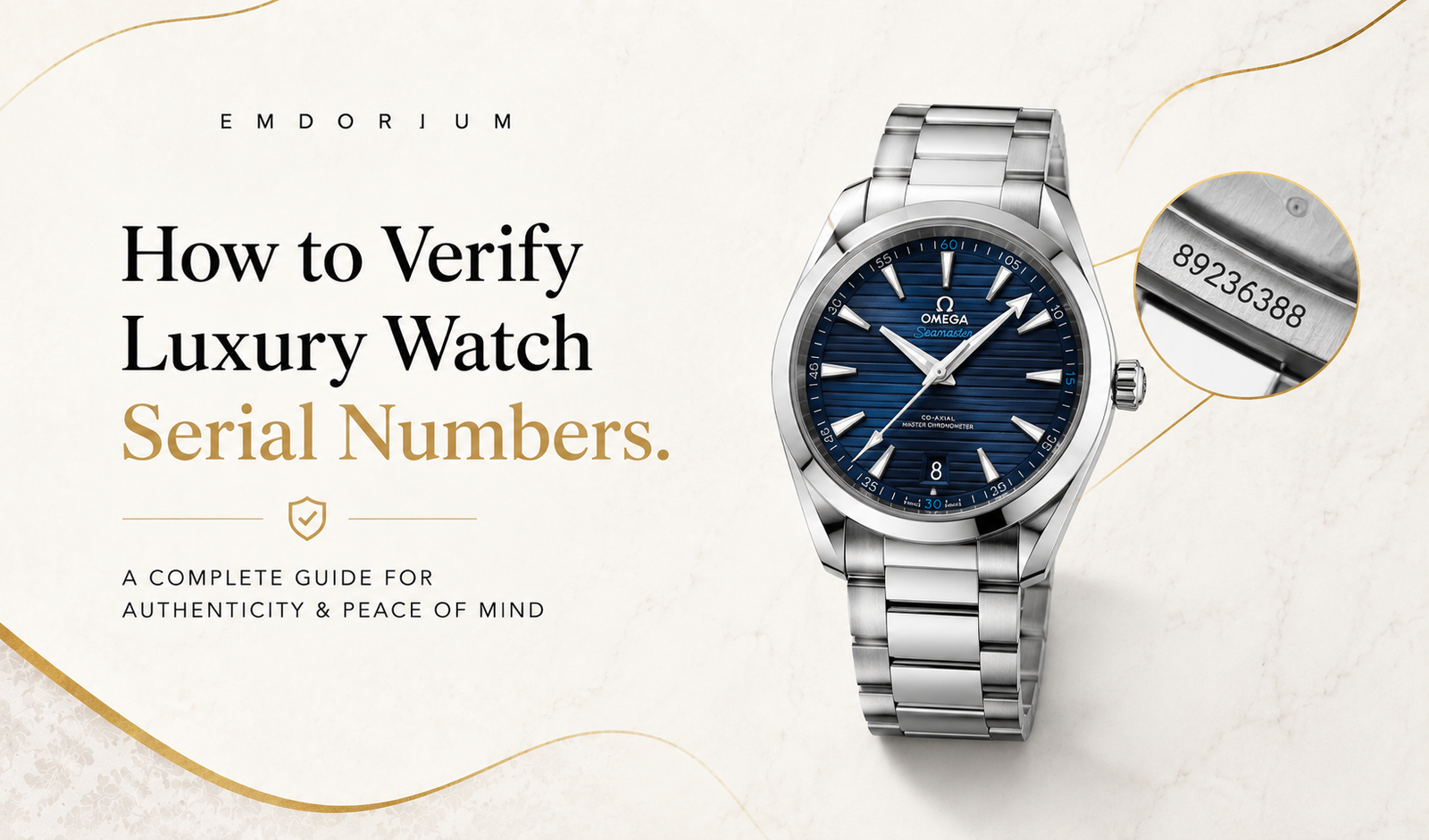
On modern Omega watches, the serial number is laser-etched in small digits on the case back. It’s typically a 7 or 8-digit number (no letters) engraved on the exterior of the case back.
On older and vintage Omega models, the serial number may be engraved on the inside of the case back or on the movement itself (visible only when the case back is removed by a watchmaker).
What genuine looks like:
Omega serial engravings are fine, precise, and consistent. On modern models, they’re laser-etched in small but perfectly legible characters. The number should be clearly readable under a loupe without any smudging, irregularity, or variation in depth.
Production dating:
Omega serial numbers followed a sequential system until relatively recently, which means you can cross-reference the number against production databases (available on sites like serial-number-decoder.com) to determine the approximate year of manufacture accurate to within a year or two.
The PIC number system:
Modern Omega watches also carry a PIC (Product Information Code) number an 8-digit code found on the warranty card and sometimes on the case back. This is different from the serial number and encodes the specific model, movement, and configuration.
Extract from the Archives:
Omega offers an official service called “Extract from the Archives” for watches older than 10 years, you can submit the serial number directly to Omega and receive an official certificate detailing the watch’s production history, original specifications, and delivery date. This is the gold standard of Omega authentication.
Hourglass Emporium Omega examples: Our Omega Speedmaster Silver Snoopy Award and Omega Seamaster Diver 300M both carry verified serial numbers matched against their warranty cards and confirmed through reference number cross-checking.
Grand Seiko
Grand Seiko serial numbers carry specific meaning that’s useful for authentication and dating.
Where to find it:
The serial number is engraved on the case back. Grand Seiko serial numbers are typically 6 digits the first digit indicates the production year (last digit of the year), and the second digit indicates the production month (1-9 for January-September, 0 for October, N for November, D for December).
Decoding example:
A serial number starting with “6A” would indicate production in January 2016 (or 2026, depending on the model era). Cross-referencing with the model reference and known production dates confirms the exact year.
What to verify:
The serial number on the case back must match the serial on the warranty card and hang tag. Grand Seiko’s finishing is so precise that the serial engraving itself is a tell genuine Grand Seiko engravings are exquisitely clean, reflecting the brand’s obsessive attention to detail.
Hourglass Emporium Grand Seiko examples: Our Grand Seiko SBGH337 Nova Purple (limited to 200 pieces) carries a serial number that can be verified against Grand Seiko’s limited production records. The Grand Seiko SBGR325 Sky-Blue (limited to 1,200 pieces) similarly carries a serial that confirms its numbered position within the production run.
Tudor
Tudor, as Rolex’s sister brand, shares some serial number conventions.
Where to find it:
On modern Tudor watches, the serial number is engraved between the lugs at the 6 o’clock position similar to older Rolex conventions. The bracelet must typically be removed to see it clearly. Some newer Tudor models also display serial information on the case back.
Cross-reference:
The serial number must match the Tudor warranty card. Tudor reference numbers work similarly to Rolex the number between the 12 o’clock lugs identifies the specific model and configuration.
Hourglass Emporium Tudor examples: Our Tudor Black Bay Pro GMT and Tudor Black Bay GMT Pepsi both carry verified serials matched against their warranty documentation.
Cartier
Where to find it: Cartier serial numbers are engraved on the case back typically a 4-letter, 4-digit alphanumeric code (e.g., ABCD1234). The reference number is separate and identifies the model.
Hourglass Emporium example: Our Cartier Santos de Cartier WSSA0048 carries the reference WSSA0048 confirmed against the serial number on the case back and warranty card.
Jaeger-LeCoultre
Where to find it: JLC serial numbers are typically engraved on the case back. The brand also uses a dual-numbering system a case serial and a movement serial both of which should be consistent with the model’s known specifications.
Hourglass Emporium example: Our JLC Reverso Tribute Monoface and Reverso Duoface Calendar carry verified case and movement serials.
Zenith, Hublot, Nomos, and Others
Zenith: Serial numbers on the case back; also carries a unique movement serial visible through the exhibition case back. Our Zenith Chronomaster El Primero has both verified.
Hublot: Serial numbers engraved on the case back, typically paired with a reference number. Our Hublot Classic Fusion King Gold carries verified serial and reference documentation.
Nomos: Serial numbers on the case back; limited editions also carry numbered case backs (e.g., our Nomos Tetra Neomatik Blue is individually numbered as part of the 175-piece run).
Longines, Frederique Constant, Movado, Christopher Ward: All carry serial numbers on the case back, cross-referenced against warranty cards.
The 5-Step Serial Number Verification Process
Whether you’re examining a watch from a private seller, a marketplace, or evaluating a potential purchase follow these five steps in order.
Step 1: Locate the Serial Number
Use the brand-specific guide above to find the serial number in the correct location. If the serial number isn’t where it should be or isn’t there at all stop immediately. That’s a fundamental red flag.
Step 2: Examine the Engraving Quality
Under a 10x loupe, the serial number engraving on a genuine luxury watch should be:
- Deep and precise not shallow or sandy
- Evenly spaced consistent gaps between all characters
- Cleanly bordered no rough edges, no bleeding
- Correctly positioned aligned with design elements (e.g., Rolex rehaut serials align with hour markers)
If the engraving looks hand-scratched, uneven, or like it was applied with a generic stamping tool the watch is suspect.
Step 3: Cross-Reference Across All Documents
The serial number must tell one consistent story across every piece of documentation:
| Element | Serial Must Match |
|---|---|
| Case engraving (rehaut or case back) | ✅ Primary source |
| Warranty card / guarantee | ✅ Must match exactly |
| Service records (if available) | ✅ Must match exactly |
| Hang tag (if available) | ✅ Must match exactly |
| Case back engraving (if different from rehaut) | ✅ Must match exactly |
If any number conflicts with any other even by a single digit the watch’s authenticity is in question.
Step 4: Verify the Reference Number
The reference number (model number) must correctly correspond to the physical watch in front of you. For example:
- Rolex reference 126334 = Datejust 41 in White Rolesor with fluted bezel
- If the watch has a smooth bezel but claims to be a 126334 there’s a mismatch
- Our Rolex GMT-Master II Rootbeer (126711CHNR) must have the Everose Rolesor case and brown/black Cerachrom bezel that reference 126711CHNR specifies
Step 5: Seek Professional Verification
For any significant purchase especially in Bangladesh where counterfeit sophistication is increasing have the serial number and watch professionally verified. A qualified watchmaker can open the case back and examine the movement serial, which provides the most definitive layer of authentication.
At Hourglass Emporium, we perform all five steps plus internal movement inspection on every watch before it enters our collection. You can reach out to our team for authentication consultation.
Serial Number Red Flags What Fakes Get Wrong
Counterfeiters have gotten better. But serial numbers remain their Achilles’ heel. Here’s what to watch for.
The “known fake” serials. Certain serial numbers appear on thousands of counterfeit watches worldwide. Counterfeiters often reuse the same handful of numbers so if your watch’s serial number appears on multiple online listings from different sellers, that’s a critical warning sign.
Wrong format for the era. A “Rolex” claiming to be a 2024 production but carrying a sequential (non-randomised) serial number is immediately suspect Rolex switched to random serials in 2010. A post-2010 watch should have an 8-character alphanumeric serial.
Shallow or uneven engraving. This is the most common tell. Genuine luxury watches use industrial laser engraving or acid-etching that produces deep, perfectly uniform characters. Fakes use cheaper methods that produce shallow, inconsistent, or slightly wobbly text.
Misalignment on the rehaut. On genuine modern Rolex watches, the serial number on the rehaut aligns precisely with the 6 o’clock hour marker, and each “ROLEX” repetition aligns with its corresponding marker. Fakes frequently get this alignment wrong even by a fraction of a millimetre, which is visible under a loupe.
Serial doesn’t match the warranty card. This is surprisingly common with “super fakes” the watch might look perfect, but the serial on the case doesn’t match the serial on the accompanying paperwork. Always cross-check. Always.
No serial number at all. Every genuine luxury watch from a reputable manufacturer carries a serial number. No exceptions. If there’s no serial it’s either heavily modified, heavily damaged, or fake.
The “too perfect” syndrome. Some sophisticated counterfeits use serials copied from genuine watches. The number might check out in a database but if the same serial appears on another watch somewhere in the world, you have a cloned serial. This is why physical inspection and trusted sourcing matter as much as number verification.
Serial Numbers vs. Reference Numbers vs. Calibre Numbers What’s the Difference?
These three numbers work together to form a complete identity picture. Understanding the distinction prevents confusion.
| Number Type | What It Is | Where to Find It | What It Tells You |
|---|---|---|---|
| Serial Number | Unique identifier for the individual watch | Rehaut, case back, or between lugs | Authenticity, production date, ownership history |
| Reference Number | Model identifier for the watch type | Between lugs at 12 o’clock (Rolex), case back (others) | Model, material, bezel type, configuration |
| Calibre Number | Movement identifier | Engraved on the movement (visible through exhibition case back or after case opening) | Movement type, complications, specifications |
All three must be consistent. A Rolex Submariner 126610LV should have:
- A randomised 8-character serial (post-2010 production)
- Reference number 126610LV (indicating Submariner Date with green Cerachrom bezel)
- Calibre 3235 inside
If any of these three don’t match the watch has either been modified, is assembled from parts of different watches (“frankenwatch”), or is counterfeit.
Quick-Reference Chart: Where to Find Serial Numbers
| Brand | Serial Location | Format | Dating Possible? |
|---|---|---|---|
| Rolex (modern) | Rehaut at 6 o’clock | 8-char alphanumeric (random since 2010) | No (need warranty card) |
| Rolex (pre-2005) | Between lugs at 6 o’clock | 4-8 digit numeric or letter-prefix | Yes (via lookup chart) |
| Omega | Case back (exterior) | 7-8 digit numeric | Yes (via production database) |
| Grand Seiko | Case back | 6-digit (1st = year, 2nd = month) | Yes (decodable) |
| Tudor | Between lugs at 6 o’clock | Numeric, similar to Rolex pre-2005 | Partially |
| Cartier | Case back | 4-letter + 4-digit alphanumeric | Limited |
| Jaeger-LeCoultre | Case back (case serial + movement serial) | Numeric | Via JLC records |
| Zenith | Case back + movement | Numeric | Via Zenith records |
| Hublot | Case back | Alphanumeric | Via Hublot records |
| Nomos (limited ed.) | Case back (numbered) | Numeric + edition number | Yes (numbered production) |
Why Serial Numbers Alone Aren’t Enough
This is the section most guides skip and it’s the most important one.
A serial number is a powerful authentication tool. But it is not proof of authenticity by itself. Here’s why.
Cloned serials exist. Sophisticated counterfeiters copy genuine serial numbers from real watches sourced from online listings, auction catalogs, or even stolen data and engrave them onto fakes. The serial might check out in a database, but the watch attached to it isn’t the one that number belongs to.
A serial doesn’t verify the movement. The serial number sits on the outside of the watch. The most definitive authentication happens inside when a qualified watchmaker examines the movement. A genuine Omega Speedmaster Moonshine Gold houses Calibre 3861 with specific finishing, bridges, and markings that no counterfeit can fully replicate.
Documentation completes the picture. The serial number is one pillar of authentication. Full documentation warranty card, original box, purchase receipt, service history forms the other pillars. Together, they create a structure of trust. Remove any pillar, and the structure weakens.
This is why buying from a trusted source matters more than any single check. At Hourglass Emporium, we don’t rely on serial numbers alone. Every watch in our collection passes a multi-point authentication process that includes serial verification, reference number confirmation, physical inspection, movement examination, documentation matching, and expert assessment. We do this because our reputation depends on it and because your investment deserves it.
You can learn about our verification standards on our About page.
Frequently Asked Questions
Q: Where is the serial number on a Rolex?
A: On modern Rolex watches (2005 onwards), it’s laser-engraved on the rehaut (inner bezel ring) at the 6 o’clock position visible when looking directly at the dial. On pre-2005 models, it’s between the lugs at the 6 o’clock side, behind the bracelet. Both locations should carry identical numbers when present.
Q: Can I verify a luxury watch serial number online?
A: Partially. Rolex does not offer a public serial number database, so you cannot verify directly through Rolex. Omega offers an “Extract from the Archives” service for watches over 10 years old. Third-party resources like Bob’s Watches and serial-number-decoder.com can help determine production dates from pre-2010 serial numbers. For definitive authentication, consult a professional.
Q: Do fake watches have serial numbers?
A: Yes most modern counterfeits include serial numbers. However, these numbers are often formatted incorrectly, engraved poorly, placed in the wrong location, or reused across multiple fakes. A serial number alone doesn’t guarantee authenticity that’s why professional multi-point verification matters.
Q: সিরিয়াল নম্বর দিয়ে কি ঘড়ি আসল কিনা বোঝা যায়? (Can a serial number tell if a watch is genuine?)
A: সিরিয়াল নম্বর যাচাইয়ের একটি গুরুত্বপূর্ণ ধাপ, তবে এটি একা যথেষ্ট নয়। সিরিয়াল নম্বর ওয়ারেন্টি কার্ড, রেফারেন্স নম্বর, এবং ক্যালিবার নম্বরের সাথে মিলতে হবে। Hourglass Emporium প্রতিটি ঘড়িতে মাল্টি-পয়েন্ট যাচাই করে সিরিয়াল নম্বর, মুভমেন্ট পরীক্ষা, ডকুমেন্টেশন ম্যাচিং সহ।
Q: What should I do if the serial number doesn’t match the warranty card?
A: Do not purchase the watch. A mismatch between the serial number on the case and the warranty card is a serious red flag it could indicate a counterfeit, a Frankenwatch (assembled from parts of different watches), or stolen documentation paired with a different watch. Walk away and consult a professional.
Q: How does Hourglass Emporium verify serial numbers?
A: We perform a comprehensive multi-point authentication process. Serial numbers are verified across the case (rehaut or case back), warranty card, and service records. We cross-reference the reference number against the physical watch configuration. We examine the movement calibre. And we assess the overall finishing, weight, and materials against manufacturer specifications. Every watch in our collection has passed this process before listing.
Q: Should I share my watch’s serial number publicly?
A: No. Never post your full serial number on forums, social media, or public listings. Counterfeiters can clone serial numbers from public posts and engrave them onto fake watches, creating convincing counterfeits that pass basic serial checks. Share serial information only with trusted professionals during authentication.
Trust, But Verify
In the luxury watch world, the phrase “trust, but verify” isn’t paranoia it’s wisdom.
A serial number is the foundation of that verification. It connects a physical watch to its history, its documentation, and its authenticity. Knowing where to find it, how to read it, and what red flags to watch for gives you a genuine advantage whether you’re buying your first luxury watch in Dhaka or adding to an established collection.
But serial numbers are just the beginning. True authentication requires expert eyes, physical inspection, movement examination, and the kind of deep brand knowledge that comes from handling hundreds of genuine (and counterfeit) watches over years.
That’s exactly what Hourglass Emporium provides. Every watch in our collection from the Rolex GMT-Master II Rootbeer to the Nomos Tetra Neomatik Blue has been serial-verified, reference-confirmed, movement-inspected, and documentation-matched before it reaches our inventory. Because we believe that the only acceptable standard for luxury watches is absolute certainty.
Have a watch you’d like authenticated? Need guidance before a purchase? We’re here to help no pressure, no obligation, just expertise.
Explore our authenticated collection at Hourglass Emporium.
📞 Hotline: +880 1973 676 591 💬 WhatsApp: +880 1973 676 591 📧 Email: info@hourglassemporium.com 🌐 Visit: hourglassemporium.com
Every genuine watch has a number. Make sure it tells the truth.